Mycotoxins in Brewing and Malting in 2025

Share this article :

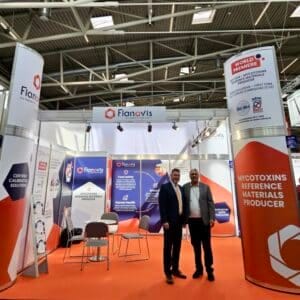
Fianovis presents once more its innovations in mycotoxin detection at the 46th Mycotoxin Workshop, Italy, 2025 – A summary of the collaboration with the Research Institute of Brewing and Malting, Czech Republic

Mycotoxins, the secondary metabolites of fungi, pose a serious problem for human health and as a result of this growing interest, they are being widely studied by scientific groups in various aspects. One of these aspects is the food industry and the associated beer production.
Mycotoxins can be present not only in the beer itself, but also in the raw materials used in its production.
Since 2008, the Research Institute of Brewing and Malting has been investigating the issue of mycotoxins. Over time, more than 10,000 samples have been analysed in different brewing and malting matrices. The French start-up biotechnology company Fianovis offers a state-of-the-art range of standards for accurate and reliable mycotoxin detection, including C13 isotopically labeled internal standards.
The collaboration between the Research Institute of Brewing and Malting and Fianovis focuses on mycotoxins in brewing and malting. It emphasizes the importance of the quality of the input raw materials, which has a significant impact on the final product, beer. The results highlight the key role of quality control in food safety, not only in brewing and malting, but also beyond.
Last news

Discover our Mixtures Mycotoxins detection

Fianovis multi-components mixtures enable you to analyze samples for multiple mycotoxins. This method significantly improves your analysis efficiency, reducing time and resources required.

Certificate of analysis

Search in progress…

Certificate of analysis: COA_FIA000199_AFB217091304.PDF

COA_FIA000199_AFB217091304.PDF

Certificate of analysis: COA_FIA000198_AFB217091304.PDF

COA_FIA000198_AFB217091304.PDF

Certificate of analysis: COA_FIA000197_AFB217091304.PDF

COA_FIA000197_AFB217091304.PDF

Certificate of analysis: COA_FIA000205_AFG217091804.PDF

COA_FIA000205_AFG217091804.PDF

Certificate of analysis: COA_FIA000204_AFG217091804.PDF

COA_FIA000204_AFG217091804.PDF

Certificate of analysis: COA_FIA000203_AFG217091804.PDF

COA_FIA000203_AFG217091804.PDF

Certificate of analysis: COA_FIA000202_AFG117091304.PDF

COA_FIA000202_AFG117091304.PDF

Certificate of analysis: COA_FIA000201_AFG117091304.PDF

COA_FIA000201_AFG117091304.PDF

Certificate of analysis: COA_FIA000200_AFG117091304.PDF

COA_FIA000200_AFG117091304.PDF

Certificate of analysis: COA_FIA000313_ZEA20010601.PDF

COA_FIA000313_ZEA20010601.PDF

SAFETY DATA SHEET

Search in progress…

[13C3]-Patulin in acetonitrile (EN) (2023-06-06) (FIA00168).pdf

[13C3]-Patulin in acetonitrile (EN) (2023-06-16) (FIA000169).pdf

[13C3]-Patulin in acetonitrile (EN) (2023-06-16) (FIA000170).pdf

[13C3]-Patulin in acetonitrile (EN) (2023-07-12) (FIA000171).pdf

15-Acetyl-Deoxynivalenol in acetonitrile (EN) (2023-06-06) (FIA000188).pdf

15-Acetyl-Deoxynivalenol in acetonitrile (EN) (2023-06-06) (FIA000189).pdf

15-Acetyl-Deoxynivalenol in acetonitrile (EN) (2023-06-06) (FIA000190).pdf

3-Acetyl-Deoxynivalenol in acetonitrile (EN) (2023-06-06) (FIA000192).pdf

3-Acetyl-Deoxynivalenol in acetonitrile (EN) (2023-06-06) (FIA000193).pdf

3-Acetyl-Deoxynivalenol in acetonitrile (EN) (2023-07-17) (FIA000191).pdf